

AI-Driven Enzyme Engineering
Built for Translation
Medvolt engineers therapeutic and industrial enzymes using integrated AI and physics-based simulations to enhance activity, selectivity, stability and developability while reducing experimental iterations
Why Enzyme Engineering Needs an AI-Driven Approach
Moving beyond trial-and-error toward structure-based, AI-driven enzyme design
Explore Vast Enzyme Design Space
Rational exploration of large mutational landscapes using structure-based modeling and protein engineering workflows.
De-risk Early
Instantly filter unstable, immunogenic, or non-selective enzyme variants using AI-guided screening before laboratory validation.
Rapid Optimization
Accelerate enzyme optimization through multi-objective scoring of activity, selectivity and stability using computational simulations.
Lab-Ready Results
Translate in silico enzyme design into experimental validation with physics-based simulations and predictive confidence.
Medvolt’s Advanced Enzyme Engineering Capabilities
Computational enzyme design from variant generation to physics-based validation
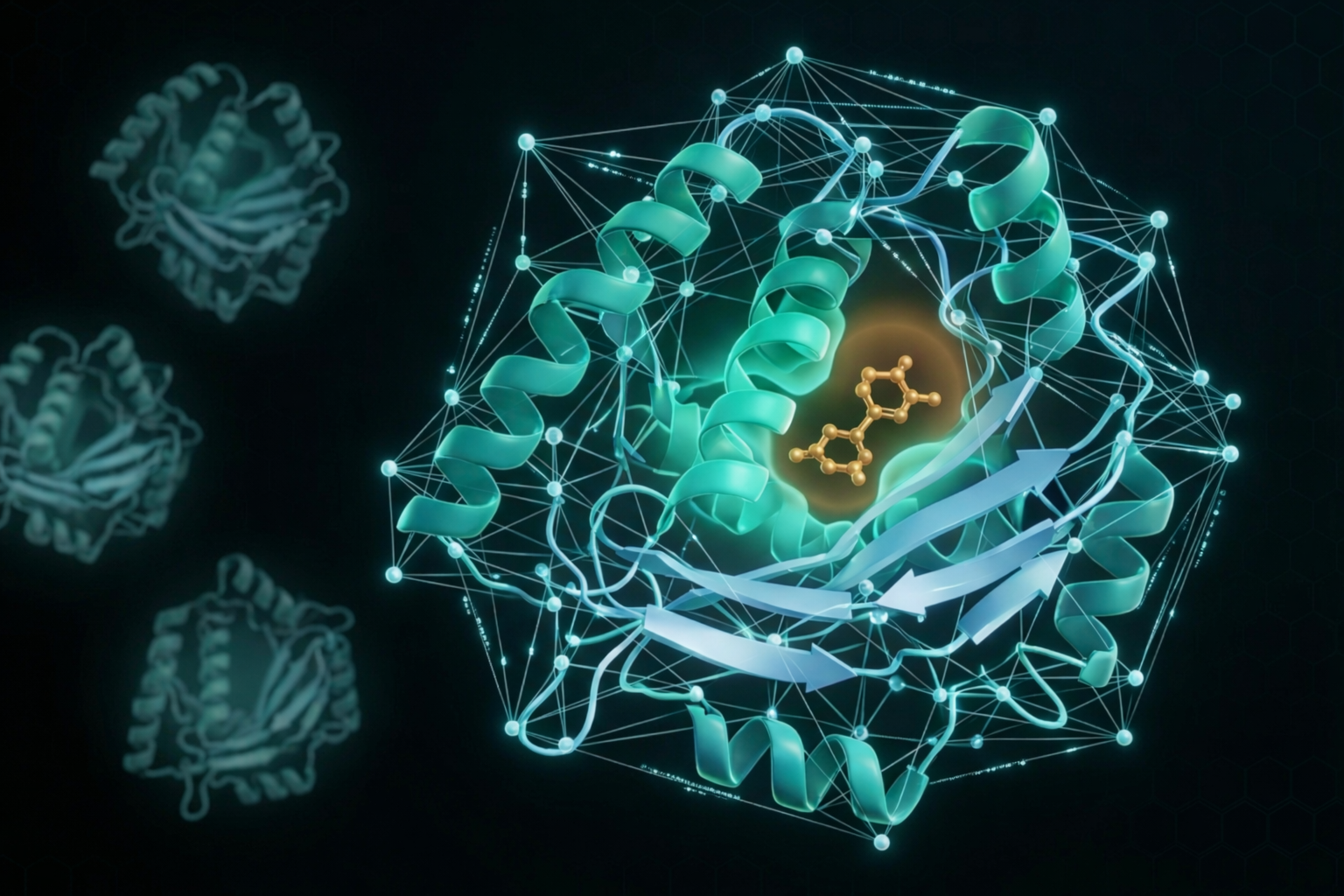
AI-Guided Variant Design
Generative AI models conditioned on enzyme structure and substrate context to optimize catalytic activity, regioselectivity and substrate specificity.

Structure-First Modeling
High-fidelity 3D enzyme and protein models preserving catalytic geometry and metal coordination, even in the absence of co-crystal structures.

Mechanism-Aware Optimization
Structure-based mutagenesis guided by enzyme-substrate interaction analysis to optimize reaction mechanisms, kinetics and regioselectivity.

Stability & Developability
Computational screening for thermal stability, folding robustness and aggregation propensity ensures downstream formulation and expression compatibility.

Immunogenicity & Safety
Early immunogenicity prediction and epitope mapping to minimize T-cell hotspots and protease-sensitive regions through targeted sequence optimization.

Physics-Based Validation
Docking, molecular dynamics simulations and free energy calculations validate enzyme-substrate binding stability, selectivity and dynamic behavior before laboratory testing.
Closed-Loop AI–Experimental
Enzyme Engineering Workflow
Medvolt’s enzyme engineering workflow integrates computational design and experimental validation into a continuous learning system
Define Objective
Target function, substrate specificity, reaction constraints and therapeutic or industrial application context
Sequence and Structure Intelligence
Homolog curation, multiple sequence alignment, structural modeling and conserved catalytic motif analysis
AI-Driven Design
Generative structure and sequence design guided by catalytic geometry, stability constraints and enzyme-substrate interactions
Multi-Parameter AI Scoring
Multi-objective scoring of catalytic activity, substrate selectivity, stability, immunogenicity and developability
Physics-Based Validation
Docking, molecular dynamics simulations and free energy calculations to validate binding stability and dynamic behavior
Experimental Handoff
Shortlisted enzyme variants delivered with structural models, binding analysis and mechanistic rationale for laboratory testing
Feedback and Model Refinement
Experimental kinetic and stability data reintegrated to retrain machine learning models and refine future enzyme design cycles
This closed-loop enzyme engineering approach reduces uncertainty, accelerates variant convergence, and continuously improves predictive accuracy through AI-driven learning
Enzyme Engineering Application Areas
Delivering therapeutic and industrial enzyme innovation through precision, structure-guided engineering

Therapeutic Enzymes
Oncology-focused therapeutic metabolic enzymes
Enzyme mimetics and mini-protein therapeutic scaffolds
Reduced immunogenicity and off-target toxicity
Enhanced half-life, stability & protease resistance

Biocatalysis and Green Chemistry
Regioselective and substrate-specific biocatalysts
Metal-dependent and industrial enzyme families
Yield optimization and metabolic pathway control
Enzyme repurposing and scaffold diversification

Enzyme Optimization and Redesign
Catalytic activity and substrate specificity tuning
Stability enhancement under industrial or therapeutic conditions
Structure-based rational mutagenesis planning
Structure-guided enzyme repurposing and redesign
What Differentiates Medvolt in Enzyme Engineering
Integrated AI + physics platform
A unified enzyme engineering platform integrating deep learning, molecular simulations, and computational chemistry
Structure- and mechanism-aware design
Every enzyme variant recommendation is grounded in 3D structure, catalytic geometry, and reaction mechanism
Explicit handling of developability
Immunogenicity prediction, stability optimization, and formulation compatibility integrated from the first computational design cycle
Closed-loop AI–experimental philosophy
Each experimental dataset retrains machine learning models, strengthening predictive accuracy across enzyme design cycles
Scalable across enzyme classes
Scalable across diverse enzyme classes, from serine proteases and metalloproteases to NAD-dependent and metal-dependent enzymes
Human expertise at every stage
AI-accelerated computational enzyme engineering guided by domain expertise at every decision stage
We do not simply generate enzyme variants. We deliver validated, high-confidence design decisions.
Collaboration Models for AI-Driven Enzyme Engineering
Flexible partnership structures for computational enzyme engineering, from rapid variant design to strategic co-development
Choose the engagement model that aligns with your scientific objectives, development timelines and internal R&D capabilities
Whether you are exploring a new enzyme class, de-risking a therapeutic enzyme candidate, or scaling a portfolio of biocatalyst programs, Medvolt integrates as a computational design engine, platform partner, or co-development team.
Enzyme Design as a Service
Dedicated AI-driven enzyme engineering teams delivering optimized enzyme variants using structure-based modeling, molecular simulations and machine learning scoring.
Best for targeted, outcome-driven enzyme optimization projects
Access to Medvolt AI + molecular simulation stack
Ideal for teams with in-house experimental validation
Strategic Planned Co-Development
Jointly executed enzyme engineering programs combining generative design, computational screening, simulations and iterative experimental feedback.
Shared roadmap and scientific governance
Integrated data infrastructure and closed-loop model refinement
Suited for therapeutic enzyme and platform-scale programs
Platform & Discovery Partnerships
Long-term enzyme engineering partnerships where Medvolt becomes the computational backbone across portfolios, indications or industrial pipelines.
Continuous AI-driven optimization across programs
Flexible commercial structures including FTE, success-based or hybrid
Best for organizations scaling global enzyme innovation
Not sure which model fits best?
We design customized AI-driven enzyme engineering collaborations aligned to your scientific risk, infrastructure and portfolio strategy.